Home / Training & organisational support
For community services, housing and education teams
Training & organisational support.
Work with Meg Bonetti on the challenges your team is carrying: the impact of frontline work, making sense of outcomes, or putting organisational change into practice.
Tailored workshops and facilitation grounded in social work, community services and leadership experience, with an understanding of rural and remote practice.

“I found the facilitator insightful and approachable.”Anonymous group participant
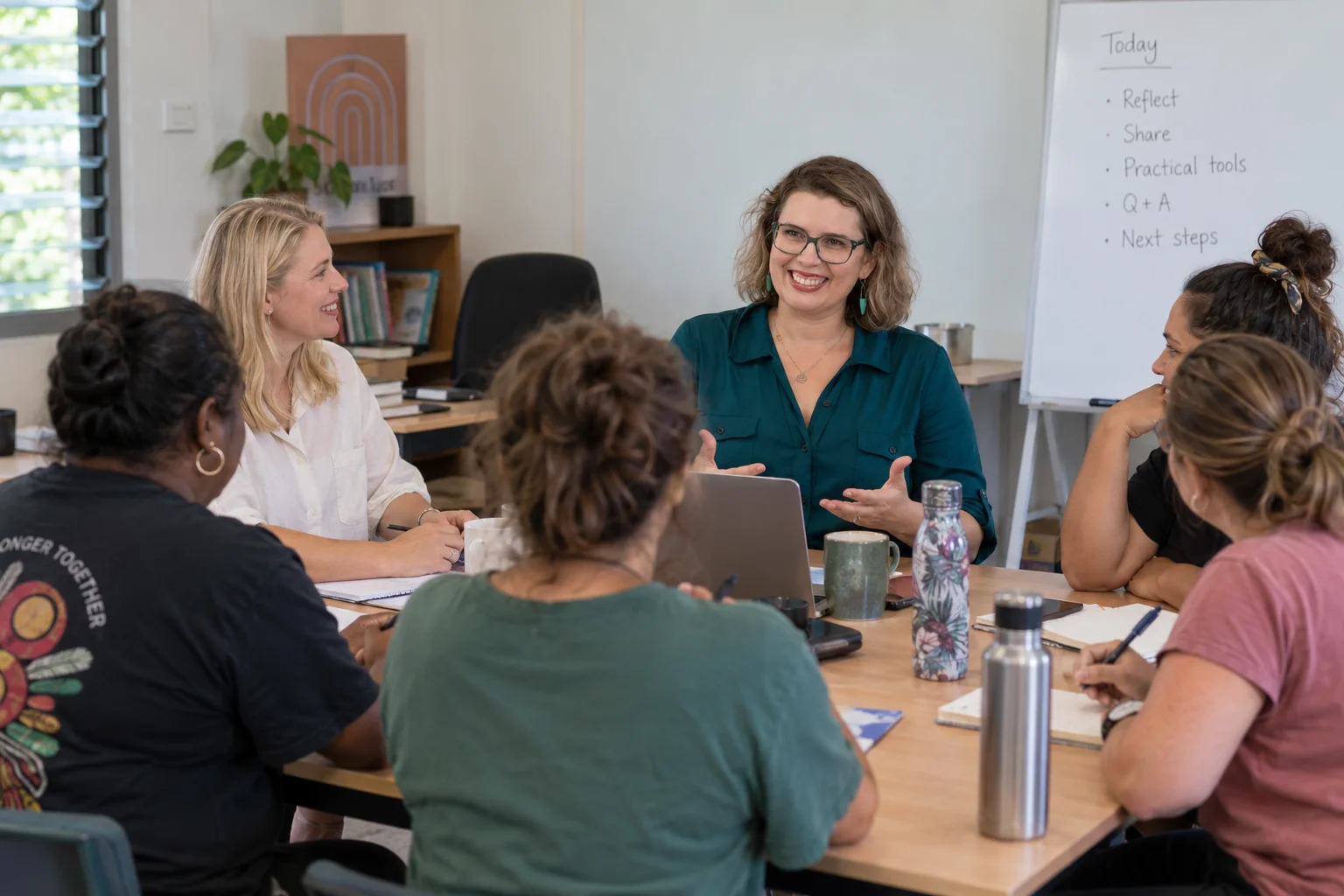
“Best group experience I’ve ever had. Loved being a group of supportive women and learning from Megan and the others.”Anonymous group participant
A starting point for your team
Vicarious trauma and sustainable practice.
For managers and frontline teams in community services, housing and education who want to understand the impact of the work and identify practical responses together.
Ask about a standalone workshop or a series, online or in person. The proposal will set out duration, preparation, resources, fees and any follow-up. Your team works towards shared language, early warning signs and actions for staff and leaders.
Supporting the workforce
Vicarious trauma and sustainable practice.
For staff and leaders who work with other people’s distress, difficult disclosures and complex service pressures.
Build shared language for vicarious trauma, secondary traumatic stress, burnout and moral distress. Explore how the work affects people and how staff, teams and organisations can respond.
- Recognise early signs of cumulative exposure and changes in boundaries, attention or empathy.
- Explore brief, optional regulation practices for demanding moments at work.
- Map responsibilities across the individual, team, organisation and wider system.
- Identify practical actions for supervision, escalation, recovery and work design.
Work towards: a shared understanding of the pressures your team faces and a practical set of staff and leadership actions. Scenarios are tailored to your setting, with no requirement to disclose personal trauma.
Training contributes to an organisation’s wider response; ongoing support and changes to working conditions matter too.
Understanding the difference your work makes
Outcomes measurement & RBA.
For programme teams and managers who need useful evidence for service improvement, planning and reporting.
Turn a broad ambition into a workable way to understand progress. Results-Based Accountability (RBA) provides a structure for asking how much you do, how well you do it, and whether anyone is better off.
- Distinguish activities and outputs from changes for people and communities.
- Clarify intended outcomes and choose indicators that help answer real questions.
- Consider what data you already have and what is realistic to collect.
- Use findings to guide decisions and explain progress to stakeholders.
Work towards: a draft outcomes map and measurement plan for a programme you bring to the workshop, including indicators, information sources and review points.
Putting change into practice
Leading teams through change.
For managers and teams introducing a service, changing ways of working, or navigating organisational transitions.
Make room for the people who will carry the change. Explore change methodology through your actual situation, connecting the intended improvement with staff involvement and day-to-day implementation.
- Define the purpose of the change and who it affects.
- Understand concerns, practical barriers and competing demands.
- Plan communication, participation and clear responsibilities.
- Identify manageable next steps and ways to review progress.
Work towards: a draft change plan that your team can develop and use, with priorities, responsibilities and review points.
Shaped around your organisation
A useful session starts with your context.
Bring a programme, a team challenge or an upcoming change. Meg will discuss your priorities and propose a scope that fits the people attending and the time available.
Discuss the need
Outline your setting, staff roles and what you would like to be different after the training.
Agree the proposal
Confirm learning aims, group sizes, session length, delivery arrangements, fees and any travel before committing.
Apply the learning
Work with relevant examples and practical activities. Resources, action planning and any follow-up are agreed in the proposal.
Ask about online or in-person delivery and availability for your location. Existing proposals are tailored to particular organisations; your fee will reflect your agreed scope.
Your facilitator
Meg Bonetti.
Meg is an Accredited Social Worker with more than twenty years of experience across direct practice, community programmes and senior leadership. She brings a social-work perspective to the relationship between people, their roles and the systems around them.
Read about Meg’s background or explore professional supervision for ongoing reflective support.
Participant feedback
Feedback from group participants about their experience of Meg’s facilitation.
“I found the facilitator insightful and approachable.”
Anonymous group participant
“Loved everything. Megan is insightful and gives everyone a chance to share”
Anonymous group participant
“Very inclusive and kind and I felt very seen.”
Anonymous group participant
“Best group experience I’ve ever had. Loved being a group of supportive women and learning from Megan and the others.”
Anonymous group participant
“Megan literally has the best sessions I’ve ever been to. The 2 different group options with her now is just so amazing! Really appreciated the org for offering 2 groups of hers. They were getting too full.”
Anonymous group participant
“The host and people in are phenomenal”
Anonymous group participant
“She was very knowledgeable and relatable.”
Anonymous group participant
“I loved this group and hope to attend again”
Anonymous group participant
Before you enquire.
Can training be tailored to our team?
Yes. The scope is agreed around your setting, participant roles and priorities. Bring a brief description of the challenge rather than identifiable client or staff information.
How long is a workshop?
Session length and the number of groups are agreed during scoping. Let Meg know whether you have a staff meeting, professional development day or a series of sessions in mind.
Can we combine topics?
Ask about the connection you need to make, such as supporting staff through change or building outcomes measurement into a new service. Meg will suggest a manageable scope.
How much does training cost?
Request a tailored proposal. Fees, preparation, resources, delivery and any travel or follow-up will be set out for you to review.
Start a conversation
Request a training proposal.
Tell Meg about your organisation and what you want the training to help with. A short outline is enough to start.